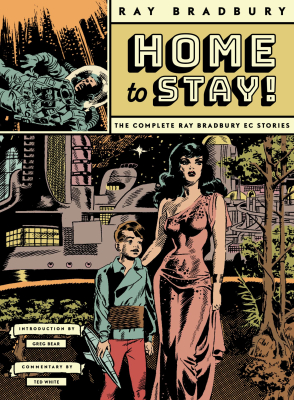
Fantagraphics collected every Ray Bradbury story ever adapted by E.C. Comics from back in the 50s. I didn't have a chance to look into it until now since it's a little pricey, so here it is. Allow me to provide a little background:
I worshiped Ray Bradbury as I started writing. He was the ideal model, a man who worked hard and kept a child-like wonder of the world around him. He embraced many things, including comics. Bradbury discovered E.C. during its golden years as they published horror, science fiction, and crime titles. He quickly realized that the story "Home to Stay" drawn by Wally Wood was a combination of elements of two stories from The Illustrated Man. He loved the story and thought it improved on his material but didn't appreciate the copyright infringement. Instead of suing, he wrote them a letter "reminding" them that they must've forgotten to send him a check. Bill Gaines, E.C.'s publisher corrected that and began a fruitful collaboration that resulted in over two dozen faithful, official adaptations and some of the greatest comics ever made.
 "The October Game" is about a bitter man who resents the daughter he never wanted and the wife who couldn't give him a son. He exacts his psychotic revenge on Halloween. The fiction writer's rule is "show, don't tell," but Bradbury uses the quiet horror writer's rule of "imply, don't show" and the picture that the reader imagines is so much worse than any artist can create. Jack Kamen, E.C.'s of the mundane respected that. The tale shocked my little 12 year old heart when I first read it.
Joe Orlando drew "The Lake," the first story that Ray was proud of having written. It is a haunting elegy of a girl who drowned at a lake and the haunted heart of the boy who loved her.
"Home to Stay" is a science fiction tale about a space pilot who kept going back to his job although his wife and son want him home. Despite its trappings in science fiction, it is really a human interest story that ends with bitter irony and false hope. Wally Wood"s natural rendering of human beings, including their form and emotional expression are pitch perfect. There's a reason Wood was comic god.
Graham Ingles, master artist of the grotesque appropriately drew Bradbury's tale, "There Was An Old Woman" about a lady who refused to stay dead. He also drew "The Handler" about a sadistic mortician who desecrates his subjects.
Several stories from The Martian Chronicles appear here, including "Mars Is Heaven!" which is depicted to perfection by Wood. This one is about explorers who arrive on Mars only to discover that it not only appears to be their hometown, it is their hometown. It is too good to be true, especially considering that some of the people they see in town had died years before. It is a disquieting horror story. Stories such as "The Million Year Picnic" and "The Long Years" were also adapted.
Other classic stories include "Zero Hour" with Jack Kamen's veneer of the everyday, proving to be a cover for an insidious plot by aliens to take over the Earth with the help of humanity's children.
Jack Davis drew many excellent stories for E.C., including Bradbury's "The Black Ferris," a wonderfully weird tale of a ferris wheel that can accelerate or reverse age. This tale was the original for what became Bradbury's excellent novel Something Wicked This Way Comes. This story has a delightfully macabre ending.
This collection was a labor of love. The only real drawback is that every story is in black and white. The coffee table hardcover size makes the book difficult to hold at times and I don't recommend carrying it around while traveling. These aren't serious complaints. The book is perfect for Bradbury fans and lovers of vintage conics. A-
P.S. I raged against plagiarism in previous articles but I'm much more understanding toward E C. because (1) they remedied their omission by paying Bradbury, (2) they changed their practice to officially licensing his stories afterwards and (3) their unofficial adaptations took bits and pieces from Bradbury and not entire plots. I am much less sympathetic to DC Comics who have yet to acknowledge Bob Kane and Bill Finger's plagiarisms of The Shadow when writing Batman, which was considerable. I can probably take the view that much like Bill Gaines, Kane and Finger's pilfering were more homage than malice, but it's still on DC Comics to own it.
Written by Nick Montelongo
I worshiped Ray Bradbury as I started writing. He was the ideal model, a man who worked hard and kept a child-like wonder of the world around him. He embraced many things, including comics. Bradbury discovered E.C. during its golden years as they published horror, science fiction, and crime titles. He quickly realized that the story "Home to Stay" drawn by Wally Wood was a combination of elements of two stories from The Illustrated Man. He loved the story and thought it improved on his material but didn't appreciate the copyright infringement. Instead of suing, he wrote them a letter "reminding" them that they must've forgotten to send him a check. Bill Gaines, E.C.'s publisher corrected that and began a fruitful collaboration that resulted in over two dozen faithful, official adaptations and some of the greatest comics ever made.
"The October Game" is about a bitter man who resents the daughter he never wanted and the wife who couldn't give him a son. He exacts his psychotic revenge on Halloween. The fiction writer's rule is "show, don't tell," but Bradbury uses the quiet horror writer's rule of "imply, don't show" and the picture that the reader imagines is so much worse than any artist can create. Jack Kamen, E.C.'s of the mundane respected that. The tale shocked my little 12 year old heart when I first read it.Joe Orlando drew "The Lake," the first story that Ray was proud of having written. It is a haunting elegy of a girl who drowned at a lake and the haunted heart of the boy who loved her.
"Home to Stay" is a science fiction tale about a space pilot who kept going back to his job although his wife and son want him home. Despite its trappings in science fiction, it is really a human interest story that ends with bitter irony and false hope. Wally Wood"s natural rendering of human beings, including their form and emotional expression are pitch perfect. There's a reason Wood was comic god.
Graham Ingles, master artist of the grotesque appropriately drew Bradbury's tale, "There Was An Old Woman" about a lady who refused to stay dead. He also drew "The Handler" about a sadistic mortician who desecrates his subjects.
Several stories from The Martian Chronicles appear here, including "Mars Is Heaven!" which is depicted to perfection by Wood. This one is about explorers who arrive on Mars only to discover that it not only appears to be their hometown, it is their hometown. It is too good to be true, especially considering that some of the people they see in town had died years before. It is a disquieting horror story. Stories such as "The Million Year Picnic" and "The Long Years" were also adapted.
Other classic stories include "Zero Hour" with Jack Kamen's veneer of the everyday, proving to be a cover for an insidious plot by aliens to take over the Earth with the help of humanity's children.
Jack Davis drew many excellent stories for E.C., including Bradbury's "The Black Ferris," a wonderfully weird tale of a ferris wheel that can accelerate or reverse age. This tale was the original for what became Bradbury's excellent novel Something Wicked This Way Comes. This story has a delightfully macabre ending.
This collection was a labor of love. The only real drawback is that every story is in black and white. The coffee table hardcover size makes the book difficult to hold at times and I don't recommend carrying it around while traveling. These aren't serious complaints. The book is perfect for Bradbury fans and lovers of vintage conics. A-
P.S. I raged against plagiarism in previous articles but I'm much more understanding toward E C. because (1) they remedied their omission by paying Bradbury, (2) they changed their practice to officially licensing his stories afterwards and (3) their unofficial adaptations took bits and pieces from Bradbury and not entire plots. I am much less sympathetic to DC Comics who have yet to acknowledge Bob Kane and Bill Finger's plagiarisms of The Shadow when writing Batman, which was considerable. I can probably take the view that much like Bill Gaines, Kane and Finger's pilfering were more homage than malice, but it's still on DC Comics to own it.
Written by Nick Montelongo
The author does not allow comments to this entry
No comments