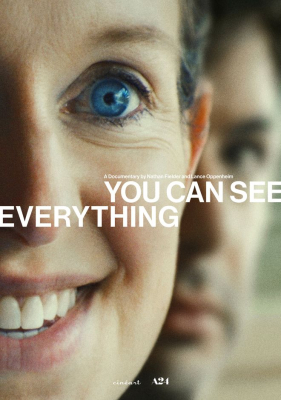
Thanks to a brilliant marketing campaign by A24, You Can See Everything is one of the most successful documentaries of all time. If it continues to draw audiences in, it may take the top spot.
You Can See Everything has become a phenomenon, which always brings forth vocal detractors. I see people moaning that they are sick of hearing about the movie. The simple remedy for that is to reduce hours spent on social media.
We see topical issues splayed about on the networks, as people confirm their biases with carefully prepared propaganda. It’s become a world of illusion, of trickery. What even is real anymore? Every day it’s getting harder to determine the truth.
 I barely knew a thing about Elizabeth Holmes before the promotional blitz of You Can See Everything. I assumed she was another corrupt billionaire.
I see a lot of reactions to Holmes and the movie. Many are convinced she is guilty, it’s as simple as that. Case closed.
Others feel Elizabeth Holmes is a victim of manipulative men.
Which is one of the points of You Can See Everything. The documentary is certainly about the Holmes case, but it also raises questions about how the public perceives cultural figures. We judge issues from memes, influencers, or maybe a TV series.
In fact, there are more questions than answers in You Can See Everything. Which is refreshing. Most documentaries try to persuade viewers to one side or the other of an issue. This one does not.
The three-hour running time breezes by, and I was as fascinated and dumbfounded as Nathan Fielder. I knew even less about him than Elizabeth Holmes before seeing You Can See Everything, but I liked the way he handled the entire situation.
I was torn as I watched it. Certainly a crime was committed, but motivation is critical in any criminal case. Is Elizabeth Holmes genuinely as guileless and innocent as she seems? I found myself feeling sympathy for her. Her husband, on the other hand, comes across as a con artist hustler.
Or is she a master of manipulation? I found that entirely plausible too.
Could someone as intelligent as Holmes not realize that she was misrepresenting her invention? At the same time, if she was as sane and normal as she would have us believe, she would have known that her product couldn’t live up to their claims.
For that matter, how did so many investors be fooled into giving so much money to an untested and unproven technology?
Then there is the previous relationship Holmes had with Sunny Balwani. Was Holmes raped before she met him, and was he another one of her abusers? Is she a victim or a predator?
Going even further, movies are produced to make money. Did Nathan Fielder and Lance Oppenheim create the shroud of mystery around Elizabeth Holmes?
I have no answers, but I love thinking about it. This is what great movies do: They keep us thinking, speculating, after the end credits roll. You Can See Everything is certainly one of the best movies of 2026 and it’s possibly the best documentary I’ve ever seen. Watch it and make your own mind up.
A24 ruffled a lot of feathers when the news broke about the company investing in AI technology. I hate it too, but I will continue to see their movies. A24 makes some of the greatest films being released today, and really, some of the best ever made. I wish AI would go away, but I’m afraid it isn’t going to. It’s like atomic energy. People could do all the No Nukes concerts they wanted, but it’s still here. CGI, ebooks, and streaming all made my world cheaper and uglier, but despite my tears, they didn’t go away.
Written by Mark Sieber
You Can See Everything has become a phenomenon, which always brings forth vocal detractors. I see people moaning that they are sick of hearing about the movie. The simple remedy for that is to reduce hours spent on social media.
We see topical issues splayed about on the networks, as people confirm their biases with carefully prepared propaganda. It’s become a world of illusion, of trickery. What even is real anymore? Every day it’s getting harder to determine the truth.
I barely knew a thing about Elizabeth Holmes before the promotional blitz of You Can See Everything. I assumed she was another corrupt billionaire.I see a lot of reactions to Holmes and the movie. Many are convinced she is guilty, it’s as simple as that. Case closed.
Others feel Elizabeth Holmes is a victim of manipulative men.
Which is one of the points of You Can See Everything. The documentary is certainly about the Holmes case, but it also raises questions about how the public perceives cultural figures. We judge issues from memes, influencers, or maybe a TV series.
In fact, there are more questions than answers in You Can See Everything. Which is refreshing. Most documentaries try to persuade viewers to one side or the other of an issue. This one does not.
The three-hour running time breezes by, and I was as fascinated and dumbfounded as Nathan Fielder. I knew even less about him than Elizabeth Holmes before seeing You Can See Everything, but I liked the way he handled the entire situation.
I was torn as I watched it. Certainly a crime was committed, but motivation is critical in any criminal case. Is Elizabeth Holmes genuinely as guileless and innocent as she seems? I found myself feeling sympathy for her. Her husband, on the other hand, comes across as a con artist hustler.
Or is she a master of manipulation? I found that entirely plausible too.
Could someone as intelligent as Holmes not realize that she was misrepresenting her invention? At the same time, if she was as sane and normal as she would have us believe, she would have known that her product couldn’t live up to their claims.
For that matter, how did so many investors be fooled into giving so much money to an untested and unproven technology?
Then there is the previous relationship Holmes had with Sunny Balwani. Was Holmes raped before she met him, and was he another one of her abusers? Is she a victim or a predator?
Going even further, movies are produced to make money. Did Nathan Fielder and Lance Oppenheim create the shroud of mystery around Elizabeth Holmes?
I have no answers, but I love thinking about it. This is what great movies do: They keep us thinking, speculating, after the end credits roll. You Can See Everything is certainly one of the best movies of 2026 and it’s possibly the best documentary I’ve ever seen. Watch it and make your own mind up.
A24 ruffled a lot of feathers when the news broke about the company investing in AI technology. I hate it too, but I will continue to see their movies. A24 makes some of the greatest films being released today, and really, some of the best ever made. I wish AI would go away, but I’m afraid it isn’t going to. It’s like atomic energy. People could do all the No Nukes concerts they wanted, but it’s still here. CGI, ebooks, and streaming all made my world cheaper and uglier, but despite my tears, they didn’t go away.
Written by Mark Sieber
The author does not allow comments to this entry
No comments