My all-horror October was fun, but by November first I was ready to get back to independent movies. Number one on my list was Late Fame, from director Kent Jones.
Willem Dafoe is the rich man’s Nicholas Cage. Both are prolific and both have portrayed dozens of intense characters. I like Cage, at least when he’s somewhat restrained, but Dafoe is obviously the superior actor.
Willem Dafoe has certainly played a wide range of characters. He was Jesus Christ, the Green Goblin, Vincent van Gogh, and controversial film director Pier Paolo Pasolini, all to perfection. Everyone loves and respects him, from film snobs to popcorn nerds.
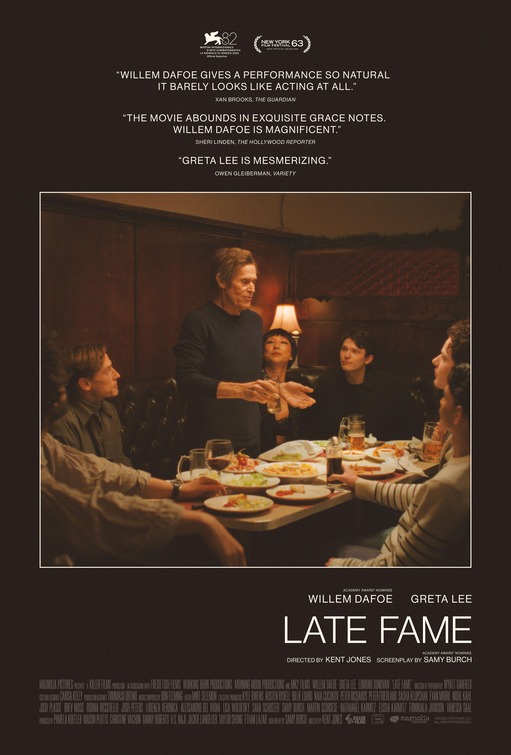 It’s great when a veteran actor takes on a quiet role. Especially when one is known for playing over-the-top characters. Like Jack Nicholson in About Schmidt or Adam Sandler in Jay Kelly. It’s harder, I think, to pull off a subtle performance, than to deliver a bombastic performance.
Dafoe is magnificent in Late Fame. He often displays more emotion from his expressions and body language than with his dialogue.
Late Fame is about a man in the late stages of his life. A humble New Yorker who works at the post office, shoots pool with his average working guy friends, and leads an unassuming life. Ed Saxberger, however, has a secret past. He once was a poet and had a volume of his work published. There was a degree of acclaim, but that was a long time ago. Saxberger is a different person now. Until his past comes knocking on his door.
An earnest young man approaches him and asks if he is the Ed Saxberger. Ed reluctantly admits it, and he is ushered into the company of a group of artists who call themselves The Enthusiasm Society. The young men are all aspiring writers and they welcome Saxberger into their circle.
The Enthusiasm Society rejects modern contrivances and romanticizes the past. They wistfully pine for a New York from a half century in the past. A time when the city was a cultural hub of painters, novelists, poets, filmmakers, and musicians. It was an era of artistic purity, unlike the corporate world of cell phones and artificial intelligence of today.
However, what exactly are the motives of The Enthusiasm Society? Do they wish to give something to Ed Saxberger? Are they befriending Ed to help bring him back to a public life, or are there ulterior motives?
I see it in artist and writer’s groups all the time. Compliments are handed out freely, but it’s a backhanded, blackmailing kind of praise that demands reciprocation. So many wish to validate themselves in the wash of acceptance from a more successful artist.
It’s not like Ed Saxberger was even asking to be rescued.
Greta Lee is also wonderful as a vivacious older woman who is sort of a big sister/love object for the boys. Her past and private life are shrouded in mystery. Who is she really? Not only that, who are any of them?
Most of us in the arts maintain a fabricated public image of ourselves, but inside we’re all scared, anxious, greedy little children who want attention and acclaim.
These things are universal and timeless. Late Fame was based on a 1894 novella by Austrian writer Arthur Schnitzler. Schnitzler also wrote Traumnovelle, which was adapted by Stanley Kubrick into Eyes Wide Shut.
Action and horror diehards might be bored by Late Fame. Its pace is leisurely and there are little or no sensational elements in the film, but the ideas and observations in it are potent. A lot of attention is paid to detail. Subtle character idiosyncrasies, nuances of behavior, the contradictory moods of a crowded room. Unlike far too many movies, it seems as though viewers are quietly observing real people.
Late Fame is mostly about performances. Saxberger seems desperate to keep himself small and hidden, while Greta Lee’s Gloria wants the world to know and love her, but from afar. The Enthusiasm Society desperately wants to be considered important artists. There’s little room for genuine emotion in such an environment.
Everyone is good in Late Fame, but Willem Dafoe shines the brightest. He’s been in demand since the mid-eighties and career is virtually unparalleled. He has never been better than in Late Fame. This is a master at work.
Written by Mark Sieber
Willem Dafoe is the rich man’s Nicholas Cage. Both are prolific and both have portrayed dozens of intense characters. I like Cage, at least when he’s somewhat restrained, but Dafoe is obviously the superior actor.
Willem Dafoe has certainly played a wide range of characters. He was Jesus Christ, the Green Goblin, Vincent van Gogh, and controversial film director Pier Paolo Pasolini, all to perfection. Everyone loves and respects him, from film snobs to popcorn nerds.
It’s great when a veteran actor takes on a quiet role. Especially when one is known for playing over-the-top characters. Like Jack Nicholson in About Schmidt or Adam Sandler in Jay Kelly. It’s harder, I think, to pull off a subtle performance, than to deliver a bombastic performance.Dafoe is magnificent in Late Fame. He often displays more emotion from his expressions and body language than with his dialogue.
Late Fame is about a man in the late stages of his life. A humble New Yorker who works at the post office, shoots pool with his average working guy friends, and leads an unassuming life. Ed Saxberger, however, has a secret past. He once was a poet and had a volume of his work published. There was a degree of acclaim, but that was a long time ago. Saxberger is a different person now. Until his past comes knocking on his door.
An earnest young man approaches him and asks if he is the Ed Saxberger. Ed reluctantly admits it, and he is ushered into the company of a group of artists who call themselves The Enthusiasm Society. The young men are all aspiring writers and they welcome Saxberger into their circle.
The Enthusiasm Society rejects modern contrivances and romanticizes the past. They wistfully pine for a New York from a half century in the past. A time when the city was a cultural hub of painters, novelists, poets, filmmakers, and musicians. It was an era of artistic purity, unlike the corporate world of cell phones and artificial intelligence of today.
However, what exactly are the motives of The Enthusiasm Society? Do they wish to give something to Ed Saxberger? Are they befriending Ed to help bring him back to a public life, or are there ulterior motives?
I see it in artist and writer’s groups all the time. Compliments are handed out freely, but it’s a backhanded, blackmailing kind of praise that demands reciprocation. So many wish to validate themselves in the wash of acceptance from a more successful artist.
It’s not like Ed Saxberger was even asking to be rescued.
Greta Lee is also wonderful as a vivacious older woman who is sort of a big sister/love object for the boys. Her past and private life are shrouded in mystery. Who is she really? Not only that, who are any of them?
Most of us in the arts maintain a fabricated public image of ourselves, but inside we’re all scared, anxious, greedy little children who want attention and acclaim.
These things are universal and timeless. Late Fame was based on a 1894 novella by Austrian writer Arthur Schnitzler. Schnitzler also wrote Traumnovelle, which was adapted by Stanley Kubrick into Eyes Wide Shut.
Action and horror diehards might be bored by Late Fame. Its pace is leisurely and there are little or no sensational elements in the film, but the ideas and observations in it are potent. A lot of attention is paid to detail. Subtle character idiosyncrasies, nuances of behavior, the contradictory moods of a crowded room. Unlike far too many movies, it seems as though viewers are quietly observing real people.
Late Fame is mostly about performances. Saxberger seems desperate to keep himself small and hidden, while Greta Lee’s Gloria wants the world to know and love her, but from afar. The Enthusiasm Society desperately wants to be considered important artists. There’s little room for genuine emotion in such an environment.
Everyone is good in Late Fame, but Willem Dafoe shines the brightest. He’s been in demand since the mid-eighties and career is virtually unparalleled. He has never been better than in Late Fame. This is a master at work.
Written by Mark Sieber
The author does not allow comments to this entry
No comments